
Adopting an employee assistance program (EAP) for your employees is a great way to help them thrive — it provides them with access to a wide range of services that cater to their overall well-being.
EAPs trace back to the late 1930s. They were initially formed to combat the rising adverse effects of occupational alcoholism. While EAPs still provide substance abuse support and alcohol rehabilitation, they have evolved and now cover several aspects of an employee’s life, including mental and emotional health, work-life balance, and financial wellness.
This guide by AllOne Health highlights the different types of EAP services and their purposes both in the lives of employees and the organizations where they work.
Which EAP Services Are the Most Popular?
The adoption of EAPs by employers across the United States, as well as globally, is on the rise. In 2024, the U.S. Bureau of Labor Statistics reported that 61% of all workers in the U.S. had access to EAPs. However, the types of EAP services to which employees have access will vary from one provider to another.
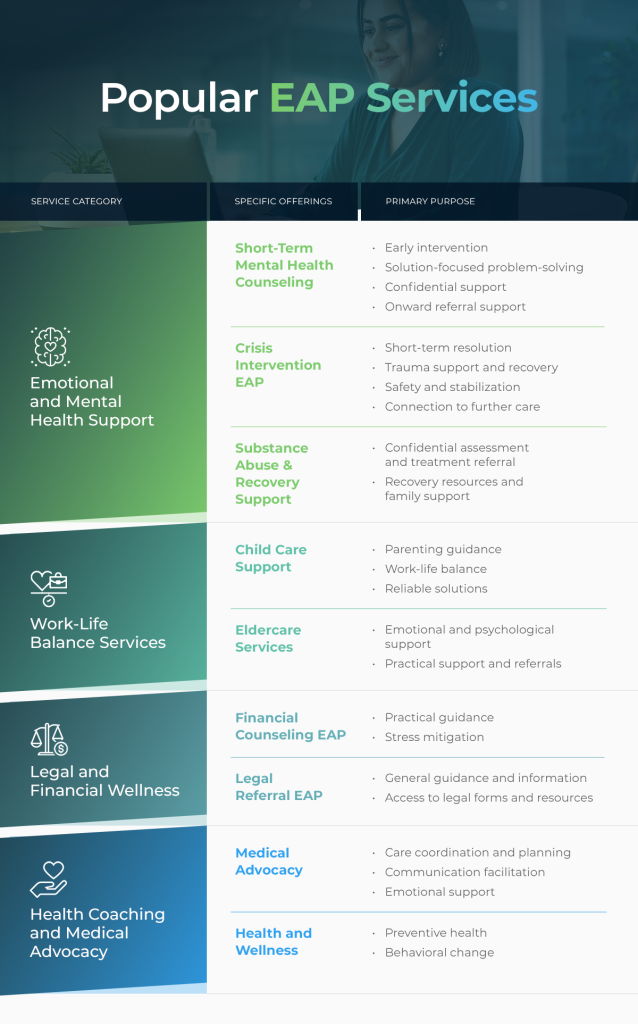
Below are the various categories of EAP services and the most popular offerings within each one.
Emotional and Mental Health Support
The purpose of each EAP service under this category is to provide support and resources to help employees effectively manage personal or work-related issues affecting their emotional or mental well-being. The ultimate goal is to prevent absenteeism and presenteeism by addressing these issues proactively. Let’s examine the most popular types of emotional and mental health support EAP services.
Short-Term Mental Health Counseling
This type of EAP service is designed to help employees address immediate mental health challenges, such as anxiety, depression, and stress. These issues, if left unaddressed, can negatively impact productivity and disrupt everyday life. Some EAP providers offer in-person or telehealth counseling services to help employees manage mental health challenges.
Some key purposes of short-term mental health counseling EAP services are:
- Early intervention: Through short-term counseling and stress management programs, EAP providers can support employees early. Such early intervention can prevent mental health issues from escalating into more severe conditions that’ll require long-term support.
- Solution-focused problem-solving: This type of mental health counseling is typically brief and solution-focused. The goal is to provide employees with immediate solutions and practical coping strategies that they can apply to enhance both their mental health in the workplace and their personal well-being.
- Confidential support: One of the primary purposes of short-term counseling is to provide employees with access to confidential support, independent of their employers or HR departments.
- Onward referral support: In some cases, employees may require specialized support for complex and chronic issues that fall beyond the scope of the EAP provider. Short-term mental health counseling serves as the initial point of assessment, after which EAP providers will offer referral EAP services and directing the employee to more suitable services.
Crisis Intervention EAP
Employees often face crises and devastating events that can negatively impact their emotional and mental well-being, including grief, work-related or personal emergencies, and traumatic experiences. For personal crises or urgent mental health needs, in-the-moment counseling is available for immediate support. For workplace crises or traumatic events affecting the collective team, the EAP offers crisis intervention services, including Critical Incident Stress Debriefings (CISDs), group or individual sessions, crisis support resources, and other intervention and response services through overarching Critical Incident Stress Management (CISM) within the EAP.
The primary purposes of crisis intervention EAP services include:
- Short-term resolution: Crises often require immediate resolutions and coping strategies to prevent escalation. Through guided counseling and resources, employees can get all or some of the support they need to manage a crisis adequately.
- Trauma support and recovery: The psychological impact of distressing events, such as the loss of a loved one, can lead to trauma. EAP providers that offer this service employ various strategies to mitigate the impact of a crisis on employees’ personal and professional lives.
- Safety and stabilization: Certain crises can throw employees off balance, causing them to lose their sense of control and stability. One purpose of crisis intervention EAP services is to provide urgent emotional support to help such employees stay safe and regain control.
- Connection to further care: Through this service, assigned counselors can assess the mental and emotional health of affected employees and connect them with specialized professionals, if long-term support is necessary.
Substance Abuse and Recovery Support
EAPs are a key resource for supporting employees with substance use and addiction concerns. Substance abuse recovery support and referral services give these employees access to confidential support, treatment, and recovery resources, as well as counseling to address and overcome addictions.
The objectives of this service are:
- Confidential assessment and treatment referral: It’s best to address substance abuse issues early on, and EAPs work to identify them at their initial stages. Early identification and intervention help to minimize and prevent the long-term consequences of addiction in employees’ personal and professional lives.
- Recovery resources and family support: EAPs provide employees with a confidential and stigma-free environment where they can get treatment or referrals without fear of immediate job repercussions.
Work-Life Balance Services
This category of EAP services focuses on helping employees manage work-life balance issues. These challenges can range from difficulty accessing child care to the rising needs of aging parents.
Juggling work and these issues can place pressure on employees, affecting their productivity and well-being. Since the 1990s, EAPs have incorporated work-life balance services — according to available data, about two-thirds of EAP providers offer them as part of their services.
Below are some of the most popular types of work-life balance EAP services.
Child Care Support
Working parents have a responsibility to care for their children while also giving their best at work. Performing this role can quickly become more overwhelming than some parents can handle, and that is where EAP-provided child care support comes into play. Child care EAP support is a service dedicated to providing working parents with the resources, referrals, and counseling they need to thrive as parents.
Child care support is a popular type of EAP service — 61% of EAP providers reported offering this service in a recent global survey. Another study by AllOne Health found that employees under the age of 40 had the highest EAP utilization rates for this service compared to other age groups.
The following are some of its crucial purposes:
- Parenting guidance: This service offers parents strategies for managing everyday parenting responsibilities and challenges, including co-parenting and caring for children with special needs.
- Work-life balance: Child care support referrals help equip working parents with the resources they need to be present and effective — both as parents at home and employees at work.
- Reliable solutions: In situations where it’s challenging for working parents to find practical solutions, such as child care providers, EAPs step in to provide referrals and other valuable information.
Eldercare Services
Caring for an aging parent or relative can bring a strong sense of purpose and fulfillment. However, doing so and handling other work and personal responsibilities can be challenging and overwhelming. Eldercare services are a popular type of EAP offering that guides employees to minimize the stress involved in caring for their aging loved ones.
A recent study conducted by AllOne Health revealed that employees aged 50 and above utilized eldercare EAP services more than employees of other age groups. This finding is understandable, given that older employees are more likely to have aged parents.
The key purposes of eldercare EAP services are:
- Emotional and psychological support: While caring for aged parents can be rewarding, it can take an emotional and psychological toll on employees who also have to succeed at work. Eldercare EAP services offer confidential counseling to better cope with the stress and emotional toll that come with caregiving.
- Practical support and referrals: Through customized referrals and support, EAPs can direct employees to find suitable eldercare solutions. Relieving the stress of caregiving and coordination helps employees concentrate more effectively at work.
Legal and Financial Wellness Services
Legal issues and financial challenges can hinder employee performance and productivity, particularly if they lack proper support. The following EAP services in this category focus on providing legal referrals and financial wellness support to employees, helping them effectively manage these issues.
Financial Counseling EAP
Financial counseling EAPs help individuals build financial wellness by addressing topics such as buying a home, budgeting, paying off debt, preventing identity theft, addressing general tax questions, and saving for tuition or retirement. A global survey revealed that out of 171 EAPs surveyed, 64% offered financial-related services. A study conducted by AllOne Health ranked financial counseling as the second most utilized EAP service, with 23% of employees using it.
The primary purposes of financial counseling services include:
- Practical guidance: EAP providers that offer financial counseling services play a vital role in helping employees find pragmatic solutions to their financial challenges.
- Stress mitigation: Financial challenges can be a significant source of stress for employees. Without proper support, they can lead to workplace anxiety and distraction. Financial counseling EAP services aim to mitigate finance-related stressors, preventing them from negatively impacting mental health and productivity.
Legal Referral
This is a common type of service most EAP providers offer. Through legal referral services, EAP providers help employees with personal legal concerns, including wills, estate planning, bankruptcy, real estate, custody, divorce, and other related matters. According to the earlier-referenced global survey, 58% of EAP providers reported offering support for legal issues.
The purposes of legal referral EAP services include:
- General guidance and information: EAP providers offer this service to provide employees with general information on everyday issues, such as real estate and housing, family law matters, traffic violations, and debt management.
- Access to legal forms and resources: A primary objective of legal referral EAP services is to refer employees to external legal experts and professionals who can provide adequate support and representation to resolve their legal issues.
Health Coaching and Medical Advocacy
Good health and workplace wellness are crucial for productivity. This category of EAP services caters to the health and wellness of employees.
The following are some of the most popular types of EAP services under this category.
Medical Advocacy
Health care systems can be complex for employees to navigate. To tackle this challenge, some EAP providers offer dedicated medical advocacy services to guide employees on issues such as health diagnoses, treatments, insurance claims, and medical bills. Another common feature of this service is liaison with medical providers to advocate for the best medical solutions for employees.
The primary purposes of medical advocacy services include:
- Care coordination and planning: This type of EAP service is designed to support employees across the medical care journey, from screening and diagnosis through treatment and follow-up. It may also cover coordinating hospital and post-discharge arrangements.
- Communication facilitation: During key decision-making processes, EAP providers play a facilitative role to ensure effective communication between all parties involved.
- Emotional support: Navigating a complex health care system while also coping with a health crisis can take a significant emotional toll on employees. A common goal of medical advocacy services is to provide emotional support to such employees and alleviate the stress of navigating complex systems.
Health and Employee Wellness
This is a type of occupational health EAP that encompasses several preventive health services designed to help employees live healthier lives and overcome obstacles they may encounter on their wellness journey. Some EAP providers offer behavioral health services that focus on vital aspects of employees’ lives, such as sleep hygiene and nutrition.
Some key purposes for integrating health and employee well-being into EAP services include:
- Preventive health: This EAP service adopts a more proactive and preventive approach than a reactive one. The goal is to help employees incorporate healthy lifestyles into their daily lives, minimizing the risks of chronic diseases and mental health issues.
- Behavioral change: Through specialized coaching and employee well-being services, EAPs help employees modify harmful behaviors, such as smoking and poor sleep habits.
Benefits of Comprehensive EAP Services
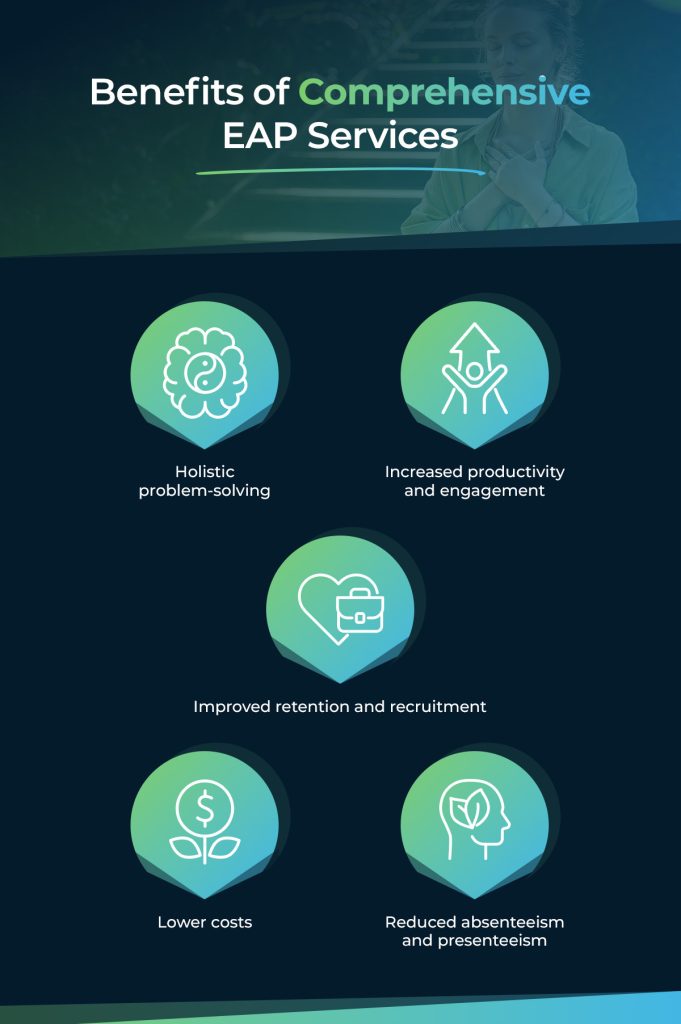
Organizations benefit from several advantages when they choose providers that offer comprehensive EAP services:
- Holistic problem-solving: With comprehensive EAP services, employees can enjoy holistic support in various aspects of their personal and professional lives. Additionally, this holistic problem-solving approach eliminates the need for employees to struggle to find extra support, as is often the case when they have access to only limited EAP services.
- Increased productivity and engagement: When employees are supported in every area of their lives, which can impact their productivity and engagement, they perform more effectively and efficiently.
- Improved retention and recruitment: Comprehensive support leads to higher job satisfaction and a more positive work culture, a feature that helps reduce employee turnover. Such a reputation also helps attract and retain top talent in a highly competitive job market.
- Lower costs: By employing proactive and reactive measures, comprehensive EAP providers help organizations save costs, such as those related to disability and health care claims and turnover expenses.
- Reduced absenteeism and presenteeism: Since EAP providers that offer comprehensive services help employees address issues early, they are more likely to be fully engaged at work and take fewer days off.
Equip Your Employees to Be Their Best All Around
Employees are the backbone of any organization. They put in their time, skills, and effort to ensure that everyday operations run smoothly, creating products and services that customers can rely on. To keep them performing at their best both in their workplace and at home, it’s essential to equip them with the support they need to thrive.
One way to achieve this is to utilize the right EAP providers that offer a comprehensive range of services to cater to the whole person. This way, employees will have all-around support to be and do their best.